
Wild-Harvested Seaweed: The Life Struggled For on Nameless Shores

2025-07-14
2025-07-14
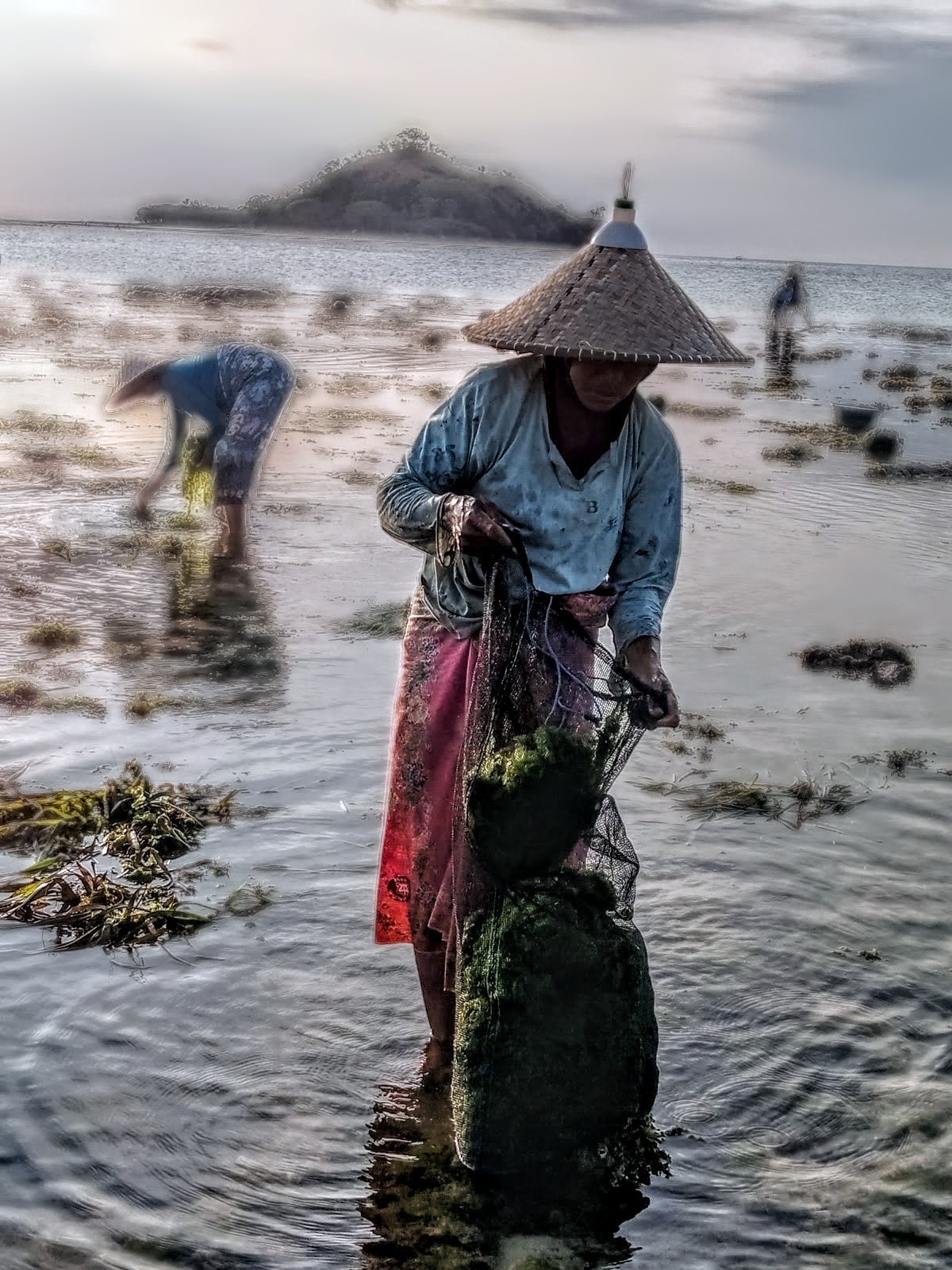
Table of Contents:
Author's Foreword — Writing Down What Is Unrecorded
Part I: Found, Not Created
1. Chapter 1 — Not Planted, But Emergent
2. Chapter 2 — Shores Visited, Not Inhabited
3. Chapter 3 — Homes of Tarpaulin, Hope from Waves
Part II: Life Between Waves and Broken Roads
4. Chapter 4 — Compressors, Boats, and Perseverance
5. Chapter 5 — Harvesters Who Come and Go
6. Chapter 6 — Between Two Worlds: Mountain and Sea
Part III: Those Who Weave Their Own Systems
7. Chapter 7 — Madam Mawar and Promises Kept
8. Chapter 8 — Unclaimed, Yet Commanded
9. Chapter 9 — Entanglements Chosen, Not Imposed
10. Chapter 10 — Invisible Chains, Unwritten Power
Part IV: What Grows from Perseverance
11. Chapter 11 — Skin Tone and Aspirations
12. Chapter 12 — Those Who Endure Are Those Who Know the Sea
Epilogue — Not Everything That Grows Must Be Planted
Author's Foreword — Writing Down What Is Unrecorded
Not everything that grows must be planted.
And not all life is recorded in development reports.
I write this because there are realities too quiet to be reported, too silent to be deemed important, yet too precious to be lost. Along nameless coasts, I witnessed seaweed growing not from seed factories or program designs, but from tenacity, happenstance, and the quiet communion between humans and the sea.
Wild-harvested seaweed—that's the term I kept hearing. Simple, perhaps even sounding 'wild' or unstructured to some. But for the coastal communities I met, that is a way of life. They do not plant, do not tie, do not shepherd—they wait, they search, and they receive what the sea permits to surface.
This writing does not present itself as a guide, nor as a technical report. It was born from small steps: from conversations on boats, from quiet afternoons behind capes, from observing lives that never felt the need to explain themselves. I am not offering formulas. I am merely striving to make space for voices often overlooked: people who walk the shores searching for signs of the season, who gather with their hands, who know how to read the wind's direction though they've never held a map.
I come from a world of measurements—of systems, devices, and digital logic. But the sea showed me that there is life that cannot be untangled by algorithms. There is value that cannot be quantified. And there is love that needs no explanation: it is felt in the willingness to await the next wave, in loyalty to a shore that promises nothing, in the courage to return even with no guarantee of bringing anything back.
If this writing feels raw, it is because it grew from an unfinished place. If it feels honest, it is because I added nothing beyond what I saw and heard myself.
May it be that as you read each part, you too can see: that behind the seaweed gathered and dried, there is a life being struggled for. Not with clamor, but with resilient silence. Not with great capital, but with small, unyielding hope.
Thank you for opening these pages.
May something within you also grow, even if you never planted it.
Darmawan Hadi
Lombok, 27 June 2025
Chapter 1 — Not Planted, But Emergent
“The sea never promises anything. But those who stay long enough at its edge know how to read the sudden bounties it offers.”
Most people know seaweed as a cultivated crop. There are names familiar to exporters, factories, even governments: Cottoni, Spinosum, Gracilaria. All can be planted, nurtured, harvested with specific patterns. Like farming—only it takes place in shallow seas. But not all seaweed grows because it's planted. Some simply appear. Not tied by rope, not anchored by bamboo poles. It emerges among corals, tossed by waves, and grows within uncontrollable currents. That is what is called wild-harvested seaweed. This type of seaweed—Sargassum, Ulva, Caulerpa, Gelidium—is not cultivated. Its growth depends on one uncertain factor: the will of the sea.
Seasons, wind, currents, waves, and temperature—all operate in irregularity. And because of this, wild harvests cannot be scheduled. It is not the result of investment, but the fruit of waiting. For this very reason, wild-harvested seaweed has never truly been part of the official industry narrative. It is not recorded in large production figures. It receives no incentives, training, or supporting technology. Yet it continues to grow. And it continues to be picked. By those who hinge their lives on the sea's generosity.
In many coastal regions of Indonesia—especially in places far from trade centers—wild-harvested seaweed becomes a quiet source of livelihood. Not grand. Not conspicuous. But real. Because it cannot be planted, it cannot be fully controlled. Because it cannot be regulated, it fosters a different way of life. It demands perseverance, not technology. It asks for presence, not possession. And beneath it all, it gives birth to a social system that grows with its own logic—between hope and doubt, between limitation and courage.
Chapter 2 — Shores Visited, Not Inhabited
“It is not blood that binds us to a place. But the courage to settle, even if uninvited.”
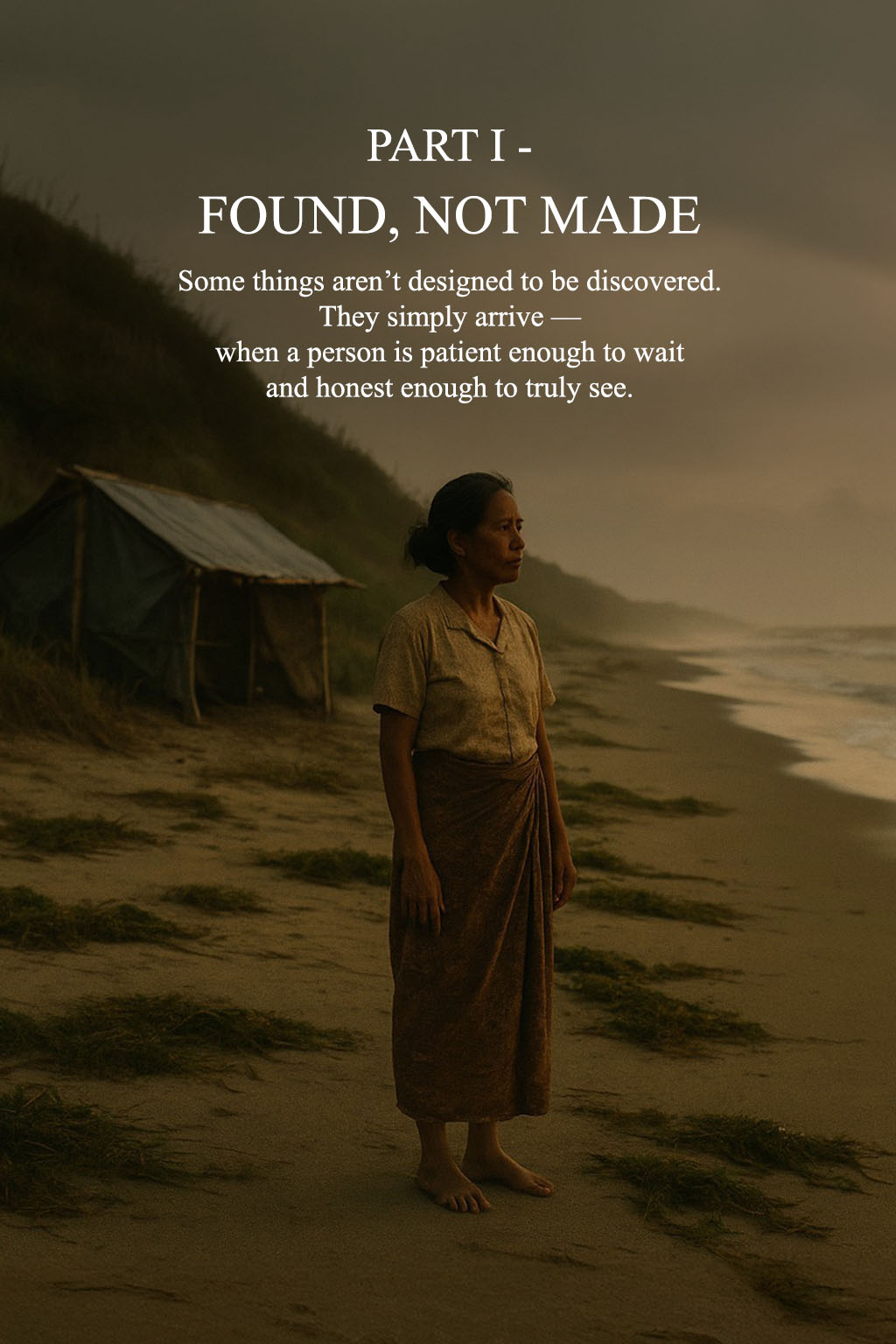
Not everyone who lives on the coast is truly a coastal dweller. Some are indeed born by the sea's edge—they grow with the roar of waves, memorize the wind's direction, and know the ocean's changing moods without needing instruments. But there are also those who come because the sea is generous. They are not heirs of the shore. They are newcomers. Not due to ancestral land, but because the sea offers opportunity.
In many places, a group of people emerged who were not originally fishermen, never even having a history with the sea. They came from farming villages, from cold mountain slopes, from shrinking cornfields and banana plantations. Then one day, news spread: on a quiet beach, wild-harvested seaweed was growing abundantly. So they came—in groups or alone. Bringing a little provision, nets, tarpaulins, and hope. At first, they harvested, dried, then left. But gradually, some chose to settle.
Makeshift homes appeared on the shoreline, made from tarpaulins, discarded planks, rusted zinc sheets. Not because they wished to build permanent lives, but because the season was not yet over, and the harvest remained abundant. Communities formed spontaneously. Without a neighborhood head (RT), without a hamlet name, without land deeds. What bound them was need. What governed them was who arrived first, who had access to the collector, who was trusted with money.
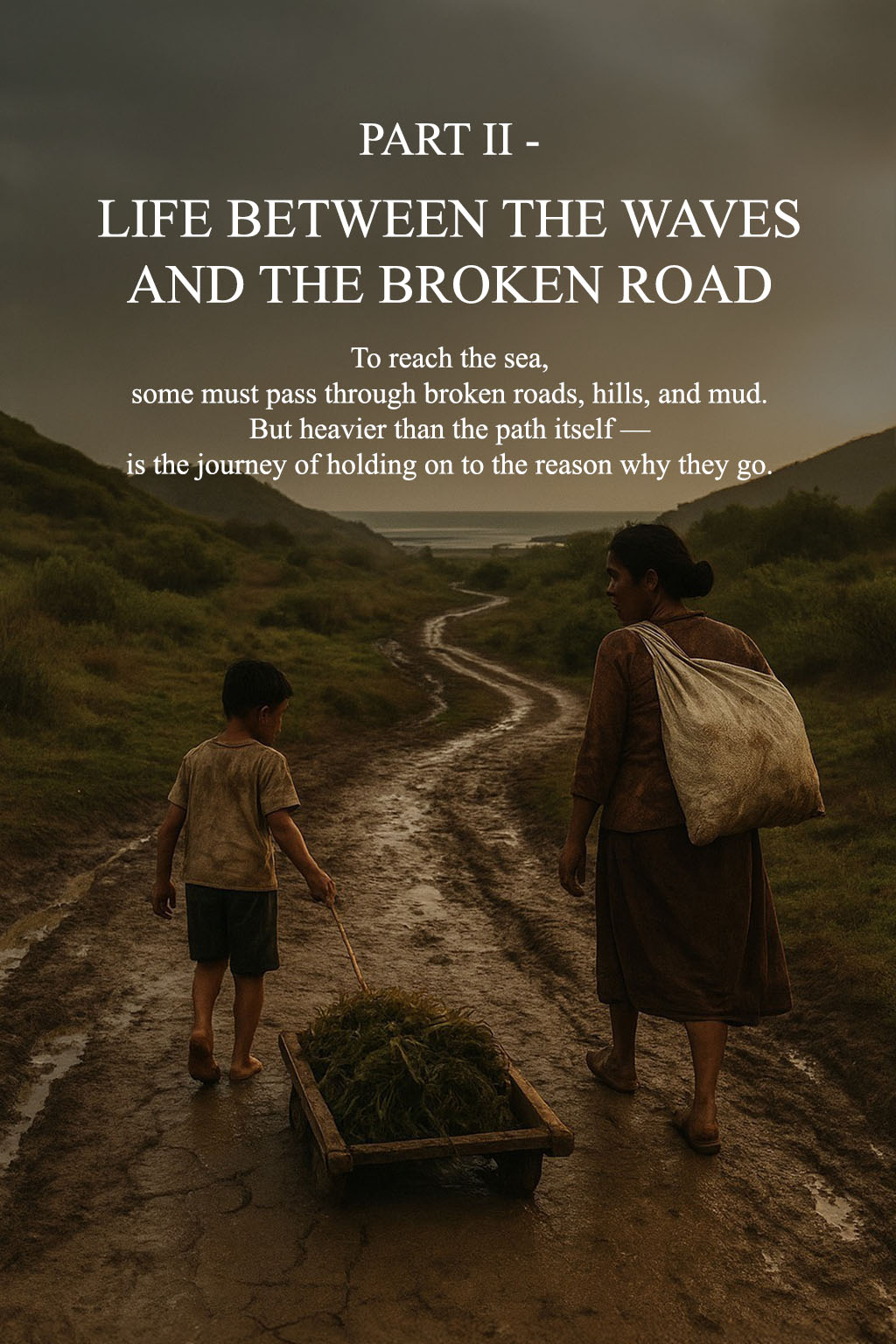
Not all shores were welcoming. Some were harsh, with high waves and sharp coral reefs. Only those daring and accustomed to working in extreme weather could endure. There were also more hospitable shores, but their locations were remote, far from roads, even impassable by vehicle. To reach such places, people had to walk for hours, cross through mud, or hire small boats to cross.
Some places could only be reached by collector boats. A group would depart together, live in makeshift huts, and return together when the harvest was deemed sufficient. They were not permanent residents. But neither were they mere guests. Their presence on those shores was not due to inherited land, but because the sea called. And from that necessity grew a community—not from a long history, but from the needs of today.
Chapter 3 — Homes of Tarpaulin, Hope from Waves
“A home is not always a building; sometimes, it is just a small space that allows us to endure one more day.”
A home is not always built on a strong foundation. On the coasts where wild-harvested seaweed thrives abundantly, homes are often just tarpaulins tied to wooden poles, or planks scavenged from the beach and market. Their roofs might be from discarded billboard plastic. Their walls have holes, floors are dirt, and wind enters from anywhere. And when heavy rain falls, sleep becomes an unpurchasable luxury. Yet behind these makeshift homes, there is a resolve far sturdier than their structures. They—the wild-seaweed harvesters—did not come to build houses. They came to live. Just for a while, enough for this season. Then perhaps to leave. Or to stay if their fortune continued. Some come alone. Some bring small children. Some breastfeed on the sand, while seaweed dries not far from a still-smoking hearth.
Sometimes, a home consists only of two narrow partitions: one for sleeping, one for storing dried harvests. There is no electricity. Clean water is carried in jerrycans from the last village reachable by motorcycle. All that remains is togetherness. Harvesters help one another. They watch each other's children when a family has to dive or search for firewood. And when the season calls again, the once-empty beach fills once more with those small huts. Like a seasonal market. Like a village that only appears when the sea is giving.
They do not come to stay forever. But they also do not know when they must leave. Because the sea is never certain. Because fortune cannot be predicted. Not all homes are built for the long term. But these homes stand for one crucial thing: survival. And for those who have slept on sand floors with leaky roofs, survival is the most honest form of hope.
Chapter 4 — Compressors, Boats, and Perseverance
“What they use are not advanced tools—only courage layered with perseverance, and lungs that believe life can continue after a dive.”
Wild-harvested seaweed does not grow by docile waters. It emerges among corals, in strong currents, or on seabeds unreachable by foot. To reach it, one must sail. Sometimes far. Sometimes to places with no name on a map. Not all who sail own their boats. Many hitch rides, rent, or crowd into the same vessel.
The boats are not large vessels, just enough to transport people, tarpaulins, and the old compressors that serve as their diving lifeline. Those compressors are not modern tools. They are usually makeshift constructions—small diesel engines connected to long hoses and rudimentary regulators. The machines roar all day, pumping air for the divers who comb the seabed, cutting clump after clump of sargassum.
They dive without formal training. Learning from elders, from fellow friends, from season to season. They know how to read currents, avoid jellyfish, and conserve energy when their bodies tire but the yield is not yet enough. One hand picks, one hand rolls. Then tied into bundles, lifted onto the boat, dried on the beach, and sold to the waiting collector. There are no safety standards. No spare tanks. Only courage and the hope that the engine won't break down in the middle of the sea. That the hose won't get snagged. That today, the harvest will be enough to buy rice and milk for their children.
When the sea gives, they work ceaselessly. When the sea is grim, they still depart, for there are no surer alternatives on land. Working at sea is gambling with the seasons. But they do not see it as gambling. They call it: the only option still possible.
Chapter 5 — Harvesters Who Come and Go
“They are not rooted to one place. But from that back-and-forth, they learn that going home is a matter of the heart, not an address.”
Not all shores bustling with seaweed harvesters were once inhabited. Many were previously quiet places, with no houses, no electricity, not even a name. Yet when the sea gives, these shores slowly transform into seasonal villages—huts stand, fires burn, and children begin to learn to chase waves.
Harvesters come from various places. From mountain foothill villages, from dry plains, from hamlets without a sea. They come because they hear news: “there's a lot of seaweed there.” They are not native coastal people. Not raised with boats and nets.
They don't know the names of winds or the temperament of waves. But they know needs. They know the price of rice. And they know how to dry their harvest under the scorching sun.
Some stay for just one season. Coming when the sea gives, returning when the season changes. They bring money, and stories. Then they come back again when the sea calls once more. Others choose to settle, erecting huts on the shoreline, transforming unclaimed land into a place to live. Their huts are not homes in the architectural sense, but homes in the sense of a presence that refuses to be expelled. They know it's not their land. But the sea belongs to no one either. They do not seek ownership. They simply want a place to dry and shelter. Occasionally, they return to their villages. For holidays, for family events, for administrative matters. But they always come back. Because in the village there is no sea, and at sea—there is hope, however faint.
Chapter 6 — Between Two Worlds: Mountain and Sea
“They were born in the mountain's chill, but endure the coast's heat. And no place can be truly called home, save for the resolve to feed their families.”
They come from cold villages, from high lands where corn, coffee, or beans are grown. Villages shrouded in morning mist, and well water that chills to the bone. They are not fishermen. They did not grow up on sand, are not accustomed to salt clinging to their skin, were not taught to read the tides. But now they spend their days on the beach. Drying marine harvests, arranging bundles of seaweed with hands once used to harvest rice. Their identity is split. They can no longer be fully called “mountain people,” nor are they considered “sea people” by those coastal dwellers who have lived there for generations.
In their home villages, they know how to connect irrigation pipes. On the beach, they know when the waves are too dangerous to dive. In their villages, they are called by childhood nicknames. On the beach, they are known as "dryers" or "suppliers." This division makes them resilient. They can adapt, but always feel temporary—as if never truly belonging to any place.
Their children, too, grow between two realms: playing in beach huts but attending school in the village, helping with drying in the morning, and doing homework at night. They are transitional humans. Their lives do not permanently relocate, yet they cannot fully return. They come not to stay forever, yet they also do not know when they must truly go home. Between mountain and sea, a new kind of human is forged: resilient, enduring, and aware that not all homes have walls.
Chapter 7 — Madam Mawar and Promises Kept
“She built no empire. She merely held promises with both hands, and walked quietly among the grander figures, carrying her own good name.”
She did not originate from this place. Not from the coast she now occupies. Not from the lineage commonly called “sea people.” She came from a more distant region, carrying a quieter spirit: to endure, not to conquer. When many came to the beach to pick, Madam Mawar came to collect. She was not a large-scale collector, nor a new player. She was in between—small enough not to be seen as a threat, but persistent enough to slowly build a network.
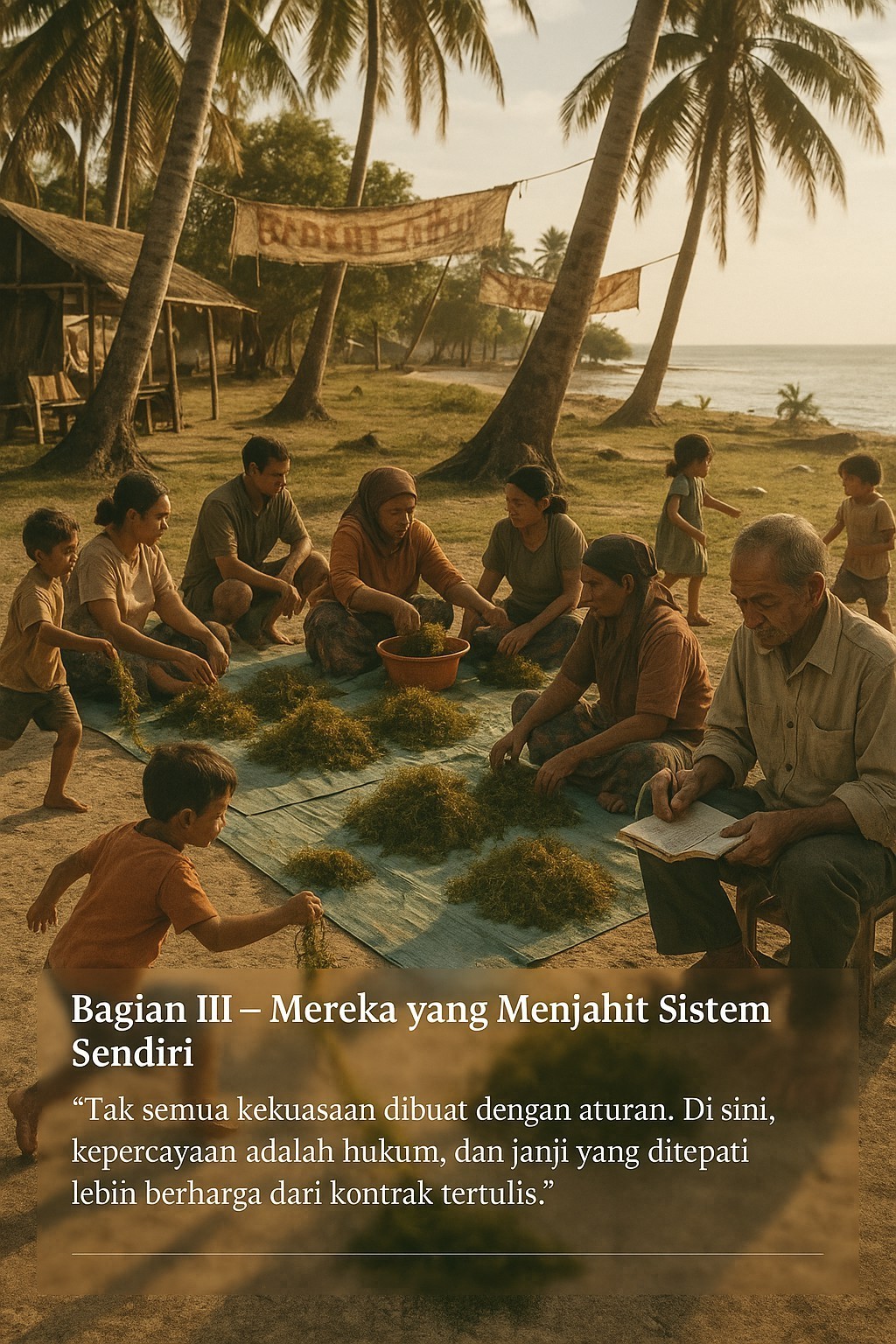
On the beach, everything seemed to be quietly parceled out. There were territories “owned” by big collectors, harvesters who were “bound” by unwritten loans or promises. And once money changed hands, the laws of commerce began to apply: the harvester worked for the one who provided the capital. This method was both subtle and harsh. Subtle because there were no contracts. Harsh because any breach could mean loss of access, even intimidation.
Madam Mawar did not have much capital. But she had one strength: punctuality in keeping promises. If she said she would pick up the harvest, she came. If she received money from a large investor, she worked hard to ensure deliveries were not missed. She slept on the beach when she was still new, in a small hut, on the bare ground, solely to ensure no harvest was disturbed, and all promises could be kept on time. Sometimes she was reprimanded by big investors, because goods were short or schedules were late. But she did not argue much. She worked harder, expanded her network of harvesters, and built trust from the ground up. And when a relationship with one investor broke down, she did not hesitate to move to another. She knew well that in this world, trust could shift—as long as she maintained her self-respect.
Her children were her motivation. On her WhatsApp status, sometimes her child's face would appear, studying in college. A clean, bright face, smiling radiantly against a backdrop of campus, library, or examination desk. Far removed from the image of the hot beach, and vastly different from her mother's sun-darkened body from years of exposure. That difference was not a painful contrast. It was proof of hard work.
Chapter 8 — Unclaimed, Yet Commanded
“That shore has no fences. But everyone knows from whom to seek permission—and to whom they must not sell their marine harvest.”
There are no certificates. No official decrees. The beach is state land, or empty land without identity. But try to enter without permission, and you will feel the invisible boundaries. Some once-quiet beaches slowly transformed into seasonal livelihoods—because seaweed grew there. And when money began to move, territories started to be “owned,” though never explicitly stated.
Usually, those considered powerful are the first to arrive, or the first to provide loans to harvesters. They are the ones who erected huts first, who have sufficient networks, and who have access to large collectors. Power does not come with weapons, but with control over distribution and silent loyalty. Whoever controls the harvesters, controls the beach. So it's no surprise if conflicts arise.
Small collectors who sneakily sell to other large collectors can be deemed “traitors.” Not only is the trading relationship damaged, but the informal ecosystem that has slowly formed becomes shaken. Sometimes conflicts end at a coffee stall. Sometimes they escalate to police reports, though formal law often fumbles when facing unregistered systems. Madam Mawar once experienced this. When her harvesters secretly sold to another collector, she became angry and cut ties. Not solely because of money, but due to a feeling of betrayal within the system of trust she herself had built.
Yet in a world like this, losing a harvester is not the end of everything. Many are ready to replace them. What is lost can be found, as long as one's good name is preserved. That beach is unclaimed. But whoever controls the flow of the harvest is considered the owner. It's not about legality, but dominance. And the powerful are not the wealthiest, but those most able to maintain stability amidst the small, daily chaos. In a space without clear legal boundaries, power arises from the ability to form a system—not from titles or positions.
Chapter 9 — Entanglements Chosen, Not Imposed
“In this place, debt is not a trap—but a relationship. As long as trust remains, even an entanglement can become a protective bond.”
Within the structure of wild seaweed harvesting, there is a seemingly simple relationship: capital providers give money, harvesters work, collectors act as intermediaries. But beneath it lies a deeper system: unwritten bonds that bind more strongly than contracts.
The money given by capital providers is not a gift. It is a debt in the form of a promise. And once money has changed hands, the recipient is no longer entirely free. Yet, what is striking is: many enter this system knowingly. They understand that receiving money means they must sell their harvest to the money provider. They grasp that prices might be lower than the open market. But they also know that without that money,
they cannot buy rice, pay for school, or simply survive a season.
This system is like a net seen from afar—but upon closer inspection, the net transforms into a place of reliance. Not because it is fair, but because it is the only one willing to share the risk with them. Capital providers also gamble: money can be lost, goods might not conform, and no official institution can protect them if cheated. Harvesters, too, gamble: if the sea does not give, then they are ensnared in unredeemable debt.
Madam Mawar understands this position well. She cannot force her harvesters, but neither is she completely free. Sometimes she is firm, knowing that leniency can make her system fragile. But she is also known for being fair, understanding that without trust, no one would sell to her. The entanglement is real. But many enter it with awareness: it is better to live with a manageable burden than to fall into an ungraspable uncertainty. In this system, entanglement does not always mean servitude. Sometimes, it is the most realistic form of cooperation: where each knows their limits and chooses to rely on one another.
Chapter 10 — Invisible Chains, Unwritten Power
“Sometimes systems are unwritten because everyone already knows how they work. And if violated, it is not the law that comes, but a warning from life itself.”
There are no inaugurations. No official decrees. But that beach has its ruler. All harvesters know whom to contact first, and whom to best avoid. This person may hold no official position, yet all harvest flows pass through them. Not due to written rules, but because of agreements built season after season.
That chain is invisible—not forged from steel or state law, but from trust that is sometimes enforced, and habits that over time come to be seen as destiny. Harvesters know they are not free. But they also know that this system provides minimal certainty: someone will buy, someone will transport, someone will ensure their harvest is not in vain.
Power like this does not oppress with loud voices, but with a silence that makes everyone feel obliged to obey. If a harvester sells to another collector, friction can arise—not directly, but through distancing. Whispers. A gradual marginalization. Because in an informal system, ostracism is more effective than open prohibition. Interestingly, this power is not always held by the wealthiest. Sometimes it belongs to the most patient, the most consistent, who know how to maintain networks and calm small daily tensions. Madam Mawar, for instance, holds no power over any beach. But she is respected because she maintains her small system with discipline. She is not a ruler of the beach, but she knows how to move the small knots that keep it functioning.
Not everyone wishes to be a ruler. Many simply desire a secure position within the system, as long as they are undisturbed, as long as they can continue to deliver their harvest and be paid sufficiently. Because in the end, this coast is not a field of power, but a field of survival. And in such a field, invisible power is precisely the most stable. In the world of wild-harvested seaweed, power relations are shaped by continuous presence, not by instruction. Those who endure are not the harshest, but those most capable of calmly maintaining the rhythm of dependence.
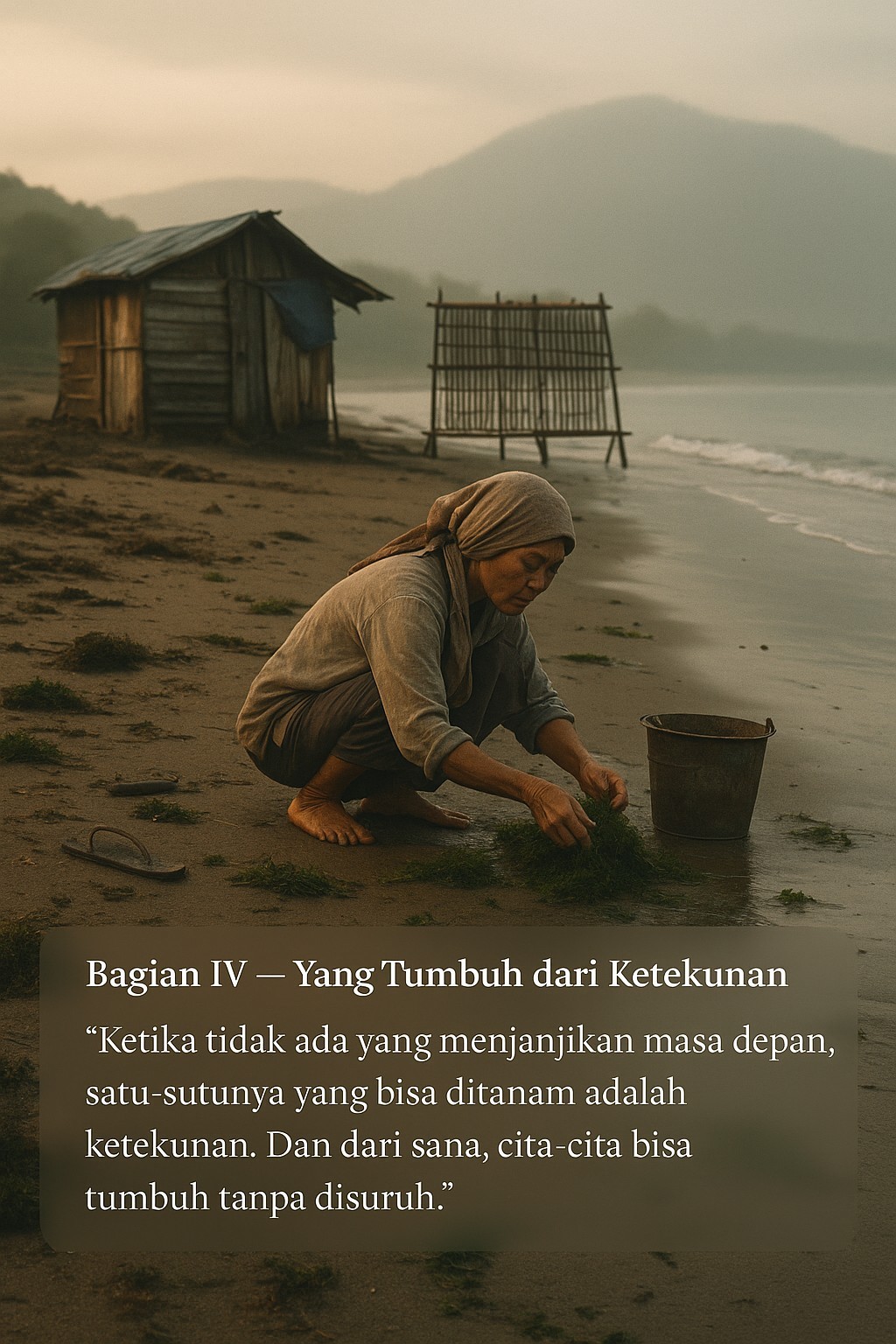
Chapter 11 — Skin Tone and Aspirations
"Her mother, dark from the sun, her child, clean on the college bench. Their skin colors are different, but both were born from the same struggle.”
Madam Mawar often changes her WhatsApp profile picture. Not her own face, but her children's. Her children's skin is fair and clean, cheeks glowing, smiles blossoming against a backdrop of campus, library, or examination desk. Far removed from the image of the hot beach, and vastly different from her mother's body, darkened by years of sun exposure. That difference is not a painful contrast. It is proof of hard work.
Madam Mawar does not want her children to follow in her footsteps, does not want them to have to sleep on the beach, guarding sacks of seaweed from night winds or sudden rain. She wants them to sit in air-conditioned rooms, think calmly, and live from knowledge, not from mud and salt. The aspiration is simple: for her children to go to higher education, to have choices, not to have to depend on the uncertain sea. But to achieve that, Madam Mawar must ensure each bundle of seaweed arrives on time. She must calculate every kilogram to be enough for data quota, rent, and tuition fees.
Many harvesters share the same hope. They know their lives are hard, but they do not wish to pass on that hardship. They want to break the chain, not the visible chain, but the chain of fate quietly inherited from season to season. Their skin colors are not the same, but blood and resolve flow from the same source. And even if their children do not return to the beach, it is not a form of betrayal. It is, in fact, a small victory achieved quietly, without speeches, without celebrations. In a harsh and uncertain life, aspirations often emerge from tired bodies and sun-scorched faces. But from there, too, grows a new generation, one that no longer needs to rely on the sea—but will never forget where they came from.
Chapter 12 — Those Who Endure Are Those Who Know the Sea
“The strong may not necessarily endure. But those who know when the sea speaks and know how to yield to it—they are the ones who will continue to live.”
Not all harvesters can endure. Many come for one season, then leave—because the yield isn't worth it, because the weather is unfriendly, or because they are tired of making a living from land they do not know. Yet some remain. Some choose to settle, even if only in the form of a hut, building a relationship with the sea like a student with their teacher: learning quietly, every day, with no guarantee of graduation.
They begin to read the signs: the changing color of the water before a season, the sound of the wind bringing seaweed faster, or when to dive and when it's enough to wait at the shoreline. They have no advanced tools, but they possess instincts sharpened by necessity. Because here, survival is not about who is strong, but who is the most patient and most diligent in understanding the sea's rhythm.
Some who once came from the mountains now know better when the west current begins. Some who once feared water are now skilled divers with old compressors. They are no longer called newcomers. They become part of the ecosystem, not just because they reside there, but because they know when to give space, when to take. Those who endure are not the wealthiest. Nor those with the most connections. Those who endure are those who know: the sea can give, but it can also take at any moment. They do not fight the sea. They learn to live with it. And that is what keeps them there, season after season, while others choose the path home. The sea never truly promises life. But for those who know how to listen to it, the sea always gives enough to survive.
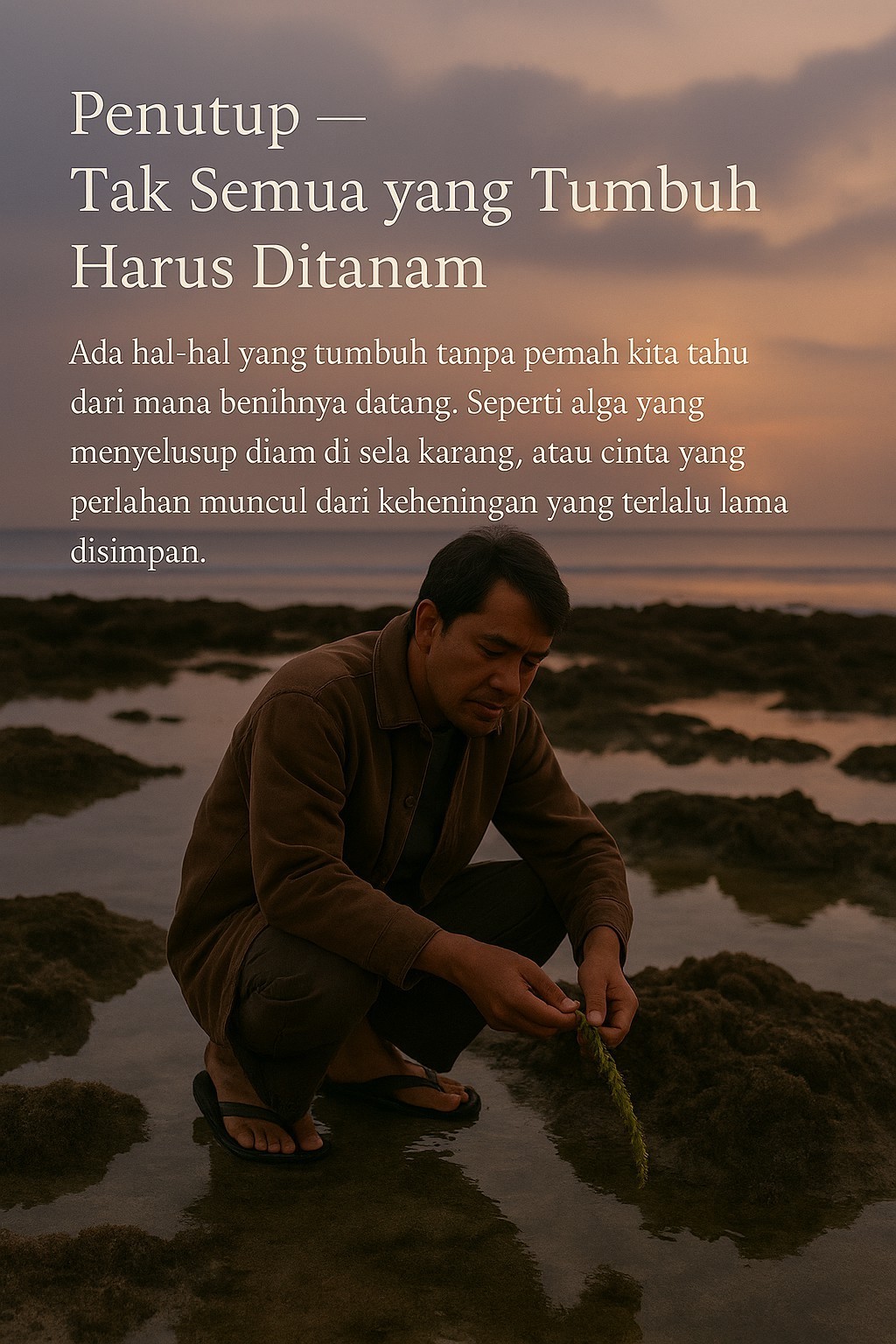
There are things that grow without us ever knowing where their seeds came from. Like algae quietly creeping among corals, or love slowly emerging from a silence too long kept. We often believe that everything must begin with intention and plan, that what grows must surely be the result of what was planted. But the sea—and life around it—taught me something different.
The sea says: sometimes, what is strongest is born from the unintentional. Sometimes, what is most meaningful is never planned. Sometimes, we only need to give space.
I did not write this to explain how to cultivate seaweed. I wrote this because I felt there was something quieter yet deeper beneath it. Seaweed is not just a harvest; it is a mirror of how humans endure. It grows with the currents, persists amidst changes, and gives without ever asking for admiration.
I saw coastal farmers living without maps, yet knowing where to step. Not all have formulas, but they know when the harvest is enough. They don't always plant, but they always give space for what wishes to grow. Amidst the onslaught of production logic and ambitions in the name of development, they continue to preserve the sea as a living space—not merely an economic field.
And I learned: love, too, is like that. It does not always come from meticulous plans. Not from who is most punctual, or who is most logical. Sometimes love grows from sincere presence, from quiet loyalty, because someone chooses not to leave even if uncalled.
In coastal life, I saw love not always taking the form of embraces or sweet words. It appeared in more subtle ways: in collecting beached seaweed, in patching a boat unasked, in waiting for the wind to subside so they could be together again on the same sea. There I learned that love is not always possessed by the ambition to own. Sometimes, love is the willingness to see something grow—even if not for us.
Not everything that grows must be planted. Not everything we love must be held. Some things appear merely to remind us that life is not about control, but about companionship. Not about binding, but about nurturing from afar. And behind all the waves that come and go, perhaps love is the only thing that remains silent yet endures.
The sea never promises anything. But it gives, in its own way. And we, humans, only need to be silent enough… to receive it.
Other Article
Introsea Webinar Series #4 : Strengthening the Upstream to Unlock Sustainable Seaweed Innovation
2026-08-05
Introsea Talkshow Series #3: Mining Green Gold from Indonesia
2026-07-08
Introsea Webinar Series #2 : Transforming Indonesia’s Seaweed Industry for Food Self-Sufficiency and Global Competitiveness
2026-06-11